
Endoscopic Mandibular Implants for Jawline Definition
Endoscopic mandibular implants for natural, permanent jawline definition. Stronger lower face contour, minimal scarring and lasting facial harmony.
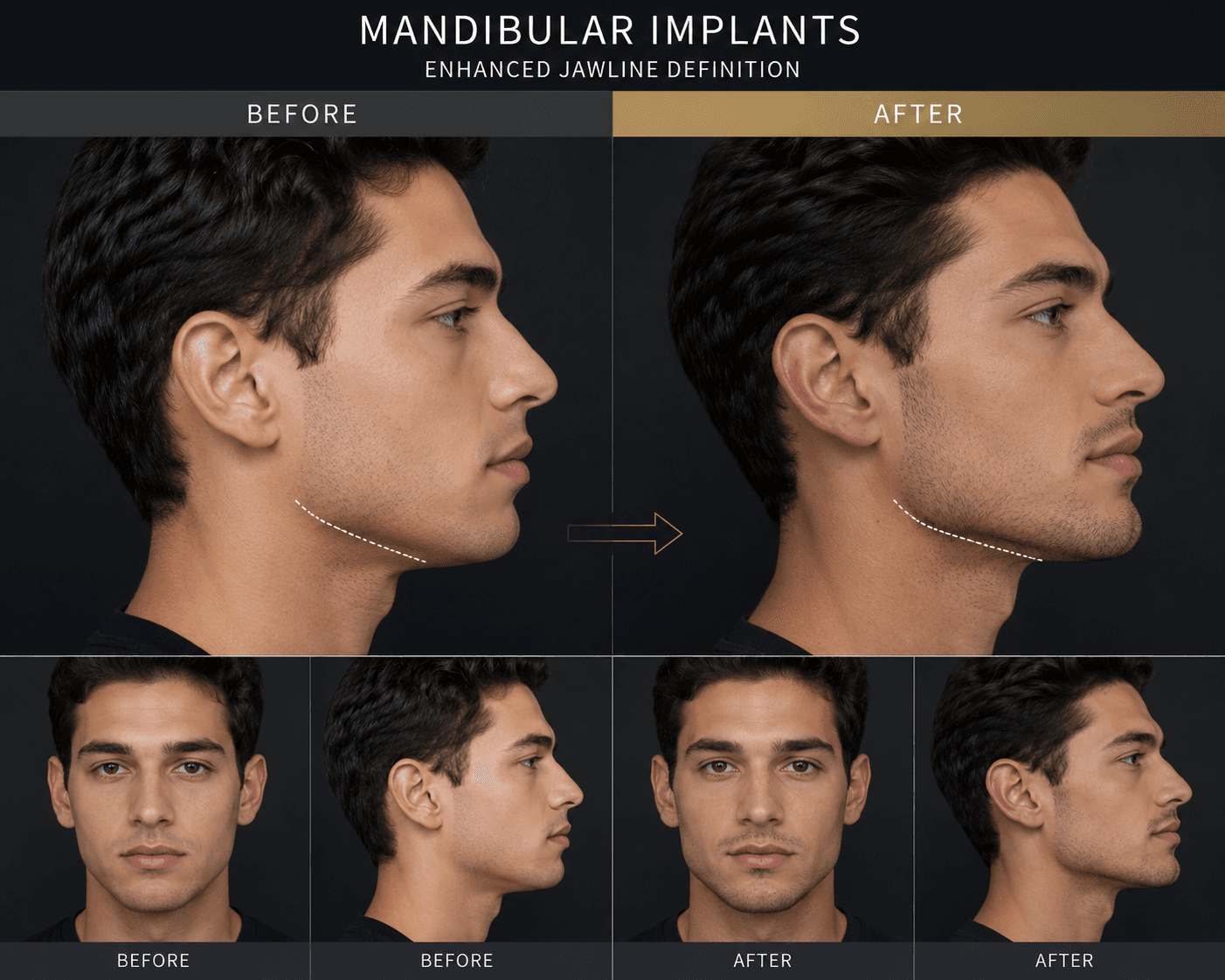
Endoscopic Mandibular Implants for Jawline Definition
Endoscopic mandibular implants are one of the most advanced approaches to jawline enhancement. They define the lower face and create structural harmony. In 2026, patients seek strong but natural jawline definition. They want facial balance — not exaggerated or artificial results.
The Role of the Jawline in Facial Aesthetics
The mandibular angle and jawline are central to facial aesthetics. A weak or poorly defined lower face directly affects:
Facial proportions
Neck contour and angle
Overall profile appearance
The balance between chin and face
Global facial symmetry
A well-defined jawline creates a younger, stronger and more harmonious appearance. It is one of the most sought-after aesthetic attributes in modern facial surgery.
What Are Endoscopic Mandibular Implants?
Mandibular implants are solid prostheses placed along the jawbone. They augment and define the mandibular angle. The endoscopic technique uses a miniature camera. It allows the surgeon to visualise anatomical structures with precision.
Advantages of the endoscopic approach:
Smaller and well-hidden incisions
Reduced tissue trauma
Better visualisation of anatomical structures
More controlled and precise dissection
Minimal or invisible scarring
Compared to traditional open techniques, the endoscopic approach is less invasive. Recovery is faster and more comfortable.
What Can Mandibular Implants Correct?
The procedure addresses multiple aesthetic concerns:
Weak jawline — creates a stronger and more elegant contour
Facial asymmetry — balances differences between both sides of the face
Unbalanced profile — improves harmony between face and neck
Poor neck contour — defines the cervicomandibular angle
Disproportionate lower face — harmonises the lower third of the face
Implants can masculinise or feminise facial structure. The outcome depends on the shape and size of the implant selected.
Types of Mandibular Implants
Several implant types are available. The choice depends on the patient's goals and facial anatomy.
Mandibular angle implants. Define the posterior angle of the jaw. Create a squarer and stronger jawline.
Mandibular body implants. Augment the lateral body of the jaw. Create a wider and more defined lower face.
Total mandibular implants. Address both the angle and body simultaneously. Deliver complete lower face contouring.
All implants are made from medical-grade silicone or porous polyethylene. They are biocompatible and safe long-term.
The Surgical Process
Understanding the procedure helps patients prepare with confidence.
Consultation. The surgeon analyses facial proportions and patient goals. A personalised surgical plan is created.
Anaesthesia. Performed under general anaesthesia or local anaesthesia with sedation.
Incision. Small and carefully hidden. Usually inside the mouth or behind the ear. No visible external scars.
Implant placement. The endoscopic camera guides the surgeon with precision. The implant is positioned along the jawbone. Fixed with titanium screws.
Closure. Incisions are closed with absorbable sutures.
The procedure typically takes one to two hours. Most patients go home the same day.
Mandibular Implants vs. Jawline Fillers
Many patients ask about the difference between implants and fillers for jawline contouring.
Jawline FillersMandibular ImplantsDuration12–18 monthsPermanentCorrectionLimitedSignificantNaturalnessVariableExcellentMaintenanceRepeatedNot requiredStructural resultNoYesMigration riskYesMinimal
For patients seeking permanent results and real structural correction, implants are the superior choice.
Combined Procedures
Mandibular implants deliver the best results when planned as part of a comprehensive facial approach. They are frequently combined with:
Genioplasty. Chin correction completes jawline definition. Creates complete lower face harmony.
Neck lift. Eliminates neck laxity. Defines the cervicomandibular angle. Complements the implant result.
Rhinoplasty. Balances the relationship between nose, chin and jaw. Creates a harmonious profile.
Deep Plane Facelift. Repositions deep facial structures. Completes lower face contouring.
Facial fat grafting. Restores lost volume. Harmonises the implant result with the rest of the face.
Recovery
Recovery varies depending on the extent of surgery. Most patients can expect:
Mild swelling and discomfort for 1–2 weeks
Soft diet for the first few weeks
Return to social activities after 2–3 weeks
Visible improvement after 4–6 weeks
Final results fully apparent after 3–6 months
The endoscopic technique reduces tissue trauma. Recovery is faster than with traditional open techniques.
Who Is the Ideal Candidate?
Mandibular implants suit patients who:
Have a weak or poorly defined jawline
Want stronger and more natural facial contour
Seek permanent results
Prefer structural correction over repeated fillers
Want to balance lower face proportions
A detailed consultation is essential. The surgeon will assess facial anatomy and recommend the most suitable implant type and size.
Trends in 2026
Jawline contouring is growing rapidly in popularity. Patients want structure, definition and naturalness. Not dramatic transformation. Just the best version of their own profile.
Current trends include:
More defined and elegant jawline
Balanced facial proportions
Strong and natural lower face contour
Permanent and authentic results
Conclusion
Endoscopic mandibular implants offer a precise and lasting solution for lower face contouring. They define the jawline, balance proportions and harmonise the facial profile — using minimally invasive techniques.
The goal is not to change identity. It is to enhance structure, balance and confidence through natural-looking and individualised results.
FAQ — Endoscopic Mandibular Implants
What are endoscopic mandibular implants? They are solid prostheses placed along the jawbone. They define the mandibular angle and contour the lower face. The endoscopic technique ensures precision and minimal scarring.
What is the advantage of the endoscopic approach? Better visualisation of anatomical structures. Smaller incisions. Reduced tissue trauma. Faster recovery than traditional open techniques.
What problems can mandibular implants correct? Weak jawline definition, facial asymmetry, unbalanced profile and poor neck contour. They can masculinise or structurally balance the face.
Will there be visible scars? No. Incisions are made inside the mouth or behind the ear. There are no visible external scars.
How is it different from jawline fillers? Fillers are temporary and need repeating. Implants provide permanent structural correction. Results are more natural and long-lasting.
How long do results last? Results are permanent. Implants are fixed with titanium screws. No repeated maintenance is required.
How long is recovery? Swelling resolves within 1–2 weeks. Social activities resume after 2–3 weeks. Final results are fully apparent after 3–6 months.
Can they be combined with other procedures? Yes. They combine well with genioplasty, neck lift, rhinoplasty, Deep Plane Facelift and fat grafting for complete facial harmony.
Are mandibular implants safe? Yes. They are made from medical-grade silicone or porous polyethylene. Fully biocompatible and safe long-term.
Who is the ideal candidate? Patients with a weak or poorly defined jawline who want stronger and more natural facial contour, permanent results and a long-term alternative to repeated filler treatments.
Want a tailored opinion? Schedule a discreet consultation with Dr. Mubariz Mammadli.
Related reading
Aesthetic medicine blog

Education
The Complete Guide to Plastic Surgery in Bucharest
A complete guide to plastic surgery in Bucharest, procedures, pricing, travel planning, and what to ask before booking.

Education
Non-Surgical Rhinoplasty: When Is It Enough?
Non-surgical rhinoplasty uses filler to smooth bumps and refine your profile temporarily, but it has real limits worth understanding.

Education
Body Contouring: Shaping the Silhouette You Want
A clear guide to body contouring surgery, liposuction, abdominoplasty, body lift and more, what each procedure does and how to choose the right one.