
Endoscopic Brow Lift: Procedure, Risks and Recovery
An endoscopic brow lift lifts the brow through small incisions behind the hairline. How it is done, who it suits, the real risks and recovery.
Endoscopic Brow Lift: Procedure, Benefits, Risks and Recovery
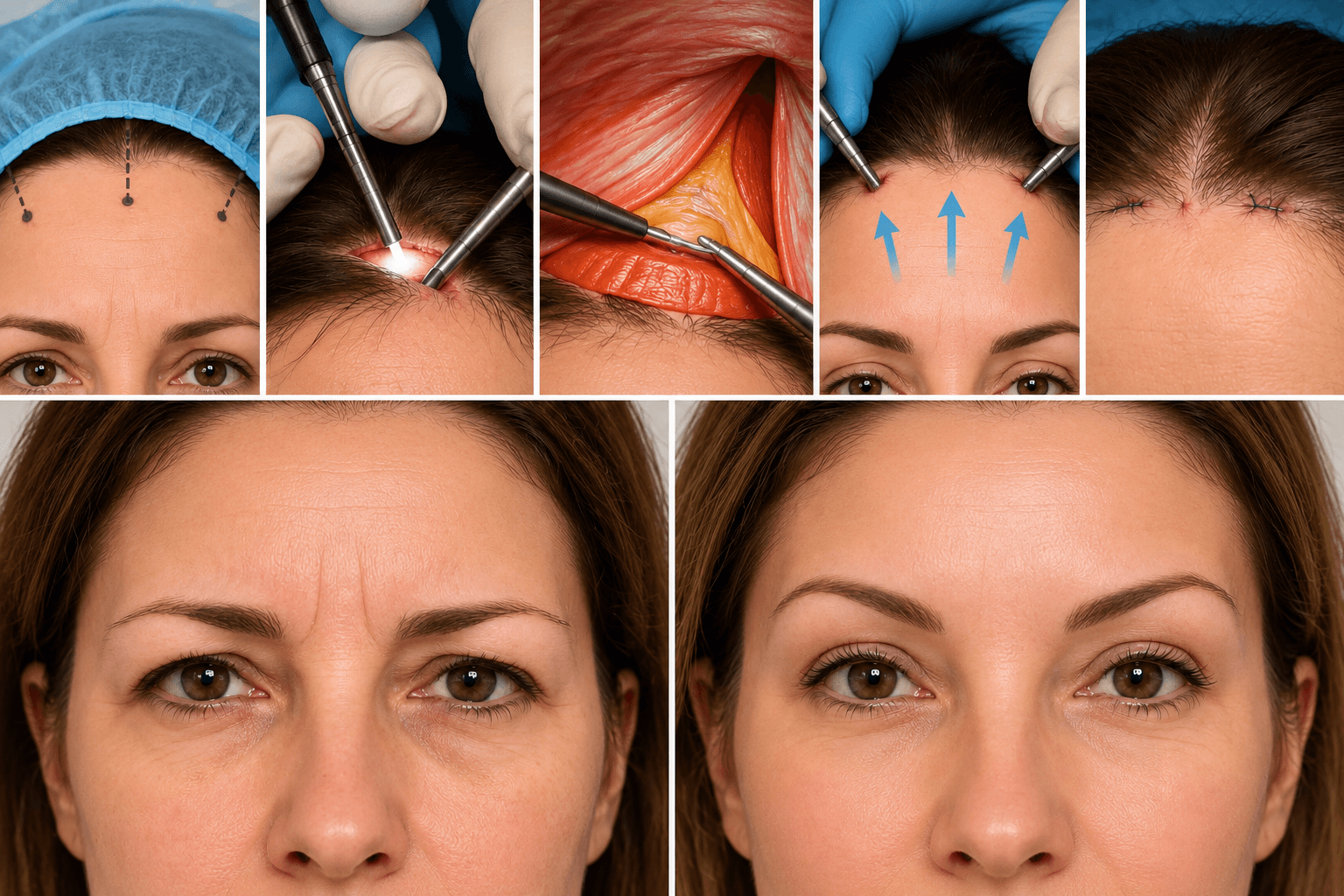
An endoscopic brow lift raises the brow and forehead through a few small incisions placed behind the hairline, with the work done under direct view through an endoscope. It is one of the less invasive ways to treat brow descent, and it is also one of the most misunderstood.
Two misunderstandings come up most often. The first is that it is a skin operation, which it is not. The second is that it leaves nothing behind, which is not true either. There are incisions, and incisions leave scars. That holds even when they sit in hair where nobody sees them.
This article sets out what the procedure involves, who it suits, what it reliably improves, what it does not, and what recovery looks like. If the change that bothers you is in the mid face or the jawline rather than the brow, that is a different operation. The deep plane and endoscopic facelift guide covers it.
What an endoscopic brow lift actually does
The brow sits on soft tissue that is held to the skull by periosteal attachments and ligaments. With age those attachments loosen and the brow drifts down. The depressor muscles between the brows keep pulling it down too, every time you frown.
The operation addresses both. It releases the attachments that hold the brow down, repositions the forehead and scalp upward, and fixes the tissue in its new position until it heals there. The depressor muscles can be weakened in the same pass.
So it is a repositioning and release operation, not a skin excision. That distinction matters, because it is the reason the incisions can be small and hidden, and also the reason the procedure cannot do everything a reader might hope.
Who it suits, and who it does not
Good candidates
The clearest indication is mild to moderate brow descent in someone whose forehead structure is otherwise intact. Published guidance adds three more. Forehead wrinkles and dynamic lines, where weakening the procerus and corrugator muscles would help. Moderate forehead laxity. And overactive frontalis or depressor muscles causing forehead strain. Results in the laxity group are described as better in younger patients with good skin elasticity.
One group is easy to miss. If you have been told you need upper eyelid surgery because of excess eyelid skin, the brow should be assessed first. EyeWiki, the American Academy of Ophthalmology reference, notes that where brow descent contributes to the problem, an isolated blepharoplasty may not meet expectations. Upper and lower blepharoplasty and a brow lift answer different questions, and they are sometimes planned together.
Brow shape is not the same target in everyone. Female brows are typically arched and sit above the orbital rim; male brows are flatter and sit on the rim. Lifting a male brow into an arch is a recognisable error rather than a better result.
Where another technique is better
Severe brow ptosis with significant skin laxity is usually better served by a direct or coronal approach. Where the priority is functional recovery of peripheral vision and the patient accepts a visible scar, a direct brow lift may be the more honest choice.
A high forehead is a reason to consider a trichophytic or pre-trichial approach instead, because lifting the scalp backwards on an already long forehead makes it longer. A thin or receding hairline is a related problem: the incisions are only hidden if there is hair to hide them in.
Limited forehead mobility, from tight anatomy or previous surgery, also counts against the endoscopic route. So does asymmetry beyond a certain point. One published threshold treats more than 3 to 4 mm of difference in brow height as a contraindication to the standard approach. Such a difference needs correcting rather than simply lifting.
Cautions worth raising before surgery
Dry eye, lagophthalmos or exposure keratopathy deserve explicit discussion. Raising the brow can worsen them, and the time to find that out is before the operation.
Chronic migraine or a neurological condition calls for careful evaluation rather than exclusion. Some forehead muscle work is done deliberately for headache in other contexts, which is exactly why it should not be done casually here.
Blepharoptosis and dermatochalasis should be identified separately. They are not treated by lifting the brow, and leaving them unnamed is how a patient ends up disappointed by a technically sound operation. Eyelid ptosis surgery is a different procedure.
The procedure, step by step
The sequence below follows the technique as described in the published literature, EyeWiki in particular. Your own surgeon's practice may differ in detail, and the details are worth asking about.
Markings and incisions
Five markings are made behind the hairline: one central, above the glabella, two paracentral, above the lateral brow, and two lateral, in the temporal crescents. The region of the supraorbital notch is also marked, across roughly 1 to 2 cm, to protect the supraorbital and supratrochlear nerves.
The central and paracentral incisions are made down to bone. The temporal incisions are taken down to the deep temporalis fascia, which is the layer that keeps the dissection away from the temporal branch of the facial nerve.
The dissection plane
Dissection is subperiosteal, carried down to the orbital rim. The endoscope is used to see the periosteal release and to identify the supraorbital nerve directly rather than working blind.
Near the supraorbital and supratrochlear nerves, blunt-tipped scissors are used in a spreading motion instead of cutting. This is the part of the operation where the endoscope earns its place.
The muscles
The corrugator and procerus are released to address the vertical and horizontal lines between the brows. This is the part that overlaps with what botulinum toxin does temporarily. The relationship is worth understanding. Surgery weakens the depressors mechanically; injections weaken them chemically and reversibly.
Patients who have had good results from injections between the brows are often good candidates, because they already know what a relaxed glabella looks like on their own face.
Fixation
Once the attachments are released, the forehead and scalp are mobilised upward and the tissue is fixed to bone. Fixation is achieved with anchored sutures or with dissolvable implants such as Endotines.
Fixation is the step that decides whether the lift holds. Ask which method your surgeon uses and why, because this is where techniques genuinely differ.
Closure
The incisions are closed with staples or suture, 5-0 nylon being one example given in the literature. An overnight compressive forehead dressing may be used. Some surgeons also prescribe oral antibiotics and a short course of oral methylprednisolone, and drains are usually not required.
Anaesthesia and operative time
The procedure can be performed under local anaesthesia alone. Published guidance nonetheless advises intravenous sedation or general anaesthesia for patient comfort, which is a comfort judgement rather than a safety one.
Where local anaesthetic is used, the relevant ceiling is 7 mg/kg for lidocaine with epinephrine. That figure is a dosing limit, not a recipe, and it is the anaesthetist's and surgeon's calculation.
Operative time is not stated consistently in the sources I could verify, and it varies with whether the brow lift is done alone or alongside other procedures. [CLINIC PROTOCOL: insert the operating time and anaesthesia used at this clinic.]
The benefits, stated precisely
What it reliably improves
Brow position is the main one. A heavy, low brow that makes the upper lid look crowded is the problem this operation is built for.
Glabellar lines improve when the depressor muscles are released, which is a structural change rather than a temporary one. Forehead strain from overactive muscles can improve as well.
The incisions are hidden in hair, which is the practical advantage over the direct and coronal approaches. The literature puts it as less visible scarring, which is the accurate phrasing.
What it does not do
It does not treat the mid face, the jawline or the neck. Those need a midface lift or a full face procedure, and expecting a brow lift to improve them is a planning error rather than a surgical one.
It does not remove upper eyelid skin, lift a drooping eyelid margin, or improve skin texture, pigment or fine surface lines. It does not stop ageing, and the brow continues to descend from its new starting point.
It is also not a substitute for a forehead lift when the forehead itself, rather than the brow, is the thing being addressed. The two are related and the terminology is used loosely, so confirm which operation is actually planned.
Scars: what the incisions leave behind
This deserves its own section, because it is where marketing language and surgical reality part company.
There are incisions. Five of them, in the technique described above, each closed with staples or sutures. They heal as scars. What is true is that they sit behind the hairline, so in someone with reasonable hair density they are not visible in normal life.
What is not true is that the operation is scar-free. Any page or advertisement describing a brow lift that way is overstating it. The overstatement matters, too. The people most likely to be let down by it are those with thin or receding hairlines, in whom the incisions are least well concealed.
Scar quality also varies between people, and hair can be permanently lost along an incision line. That is covered under risks below rather than hidden here.
Risks and complications
The sources I was able to verify describe which complications occur without publishing rates for the endoscopic technique specifically. I have therefore not attached numbers to them. If you want figures in your consultation, ask your surgeon for their own series and for the published rates they rely on.
Nerve-related
The supraorbital and supratrochlear nerves run in the operative field, which is why they are marked and why dissection near them is done by spreading rather than cutting. Injury causes numbness or altered sensation across the forehead and scalp.
The temporal branch of the facial nerve is the serious one. It is why the temporal dissection stays on the deep temporalis fascia. Injury affects the ability to raise the brow.
Altered sensation after forehead surgery is often temporary. Numbness is described in the literature as a particular drawback of the more open approaches.
Hair and scalp
Hair loss along an incision can occur and can be permanent. Scalp numbness behind the incisions is common early on.
This risk group is the reason hairline and hair density are assessed before the technique is chosen, not after.
Asymmetry and relapse
Faces are asymmetrical before surgery and remain so after it. Where brow height already differs, that difference needs correcting deliberately, and residual asymmetry is a recognised outcome rather than a surprise.
Relapse, meaning descent of the lifted brow over time, is the question fixation is meant to answer. Long-term stability has been examined in a systematic review and meta-analysis in the literature, and that is the right source for durability figures. I could not retrieve its results to quote them accurately here, so no figure is given rather than an approximate one. [CLINIC PROTOCOL: if you want a durability figure in this article, supply the source and the number and I will insert both.]
Eye-related
Raising the brow changes eyelid closure dynamics. In someone with pre-existing dry eye, lagophthalmos or exposure keratopathy, symptoms can worsen.
Bleeding and infection are the general surgical risks and are described as uncommon. Skin irregularity, folds or residual laxity are also reported.
Recovery
The verified landmark is the first post-operative visit, usually about seven to eleven days after surgery, when staples are removed. An overnight compressive forehead dressing is common, and drains are generally not needed.
Beyond that, recovery timelines are clinic protocol rather than published fact, and they vary with whether the brow lift was done alone or combined with other procedures. [CLINIC PROTOCOL: insert the swelling and bruising window, when hair can be washed, when exercise can resume, when patients typically return to work and social life, and when the final result is expected.]
One point of caution on the last of those. Different pages across this practice currently state different intervals for when brow lift results are final, and a patient who reads two of them will notice. It is worth settling on one figure and using it everywhere.
Two general expectations hold regardless of protocol. Swelling moves downward with gravity, so bruising around the eyes after forehead surgery is normal rather than a complication. And the result you see in the first fortnight is not the result, because fixation, swelling and tissue settling all change the brow position over the following months.
Frequently asked questions
Is an endoscopic brow lift scar-free?
No. There are small incisions behind the hairline, and they heal as scars. The accurate claim is that the scars are concealed in hair and so are not visible in normal life, which is different from their not existing. In thin or receding hairlines they are less well hidden.
Will it fix my hooded upper eyelids?
Sometimes partly, and sometimes not at all. If brow descent is crowding the lid, lifting the brow helps. If the problem is excess eyelid skin itself, blepharoplasty is the operation, and the two are often assessed together rather than one instead of the other.
How is it different from botulinum toxin for the brow?
Injections weaken the muscles that pull the brow down, temporarily and reversibly, and produce a modest lift. Surgery releases the attachments holding the brow down, repositions the tissue and fixes it there. One is maintenance, the other is structural.
Am I too young or too old for it?
Neither age decides it on its own. The indication is brow descent that bothers you, with intact forehead structure and enough hair to conceal the incisions. Forehead laxity responds better in younger patients with good skin elasticity, while severe descent with heavy skin laxity may call for a different technique entirely.
Will my brows look surprised?
That appearance comes from over-elevation and from lifting the wrong part of the brow, not from the technique itself. Male and female brows have different natural shapes and positions, and the plan should state where your brow is going rather than simply that it is going up.
How long does it last?
The release and the muscle work do not reverse, and fixation is designed to hold the new position while it heals. Ageing continues from the new starting point. Long-term stability has been studied specifically, and that literature, rather than a clinic estimate, is the right basis for any number you are quoted.
Can it be combined with other procedures?
Yes, and it frequently is, most often with blepharoplasty or with a midface or full face procedure. Combining changes the recovery, so ask for the recovery plan for the actual combination rather than for the brow lift alone.
Arranging an assessment
A useful consultation starts from what bothers you rather than from the name of a procedure. Bring two or three photographs of yourself from several years ago in ordinary light, and say plainly how much social downtime you can take.
The endoscopic brow lift treatment page sets out how the procedure is offered here, and the blog covers related procedures in more detail. On the international site, the brow lift service page and the assessment request are the equivalents.
To discuss whether this is the right operation for your brow, [VERIFY URL: insert the English contact page address] is the place to start.
Outcomes, recovery and risks vary between patients. The procedure descriptions above follow the published surgical literature and not a guarantee of any individual result. Any treatment decision should follow an individual examination and a full discussion of the alternatives, including the option of doing nothing. If you take prescribed medication, do not stop it or change the dose on your own before surgery. Discuss it with the doctor who prescribed it and with the team that will treat you.

About the author
Dr. Mubariz Mammadli
Plastic surgeon
Dr. Mubariz Mammadli offers advanced plastic surgery and aesthetic treatments in Bucharest, Naples and Baku, with a refined, patient-first approach.
View full profileRelated treatment
Want a tailored opinion? Schedule a discreet consultation with Dr. Mubariz Mammadli.
Related reading
Aesthetic medicine blog

Education
8 Facial Rejuvenation Methods: Which Is Most Effective?
Facial rejuvenation methods compared: what each of the 8 actually fixes, how long it lasts, and why the most effective one depends on your face.

Education
Endoscopic Facelift: Benefits, Procedure, and Recovery
What an endoscopic facelift can and cannot achieve, how the procedure works, what recovery involves, and who tends to be a suitable candidate.
Education
Lip Lift Surgery: Natural, Balanced and Defined Lips
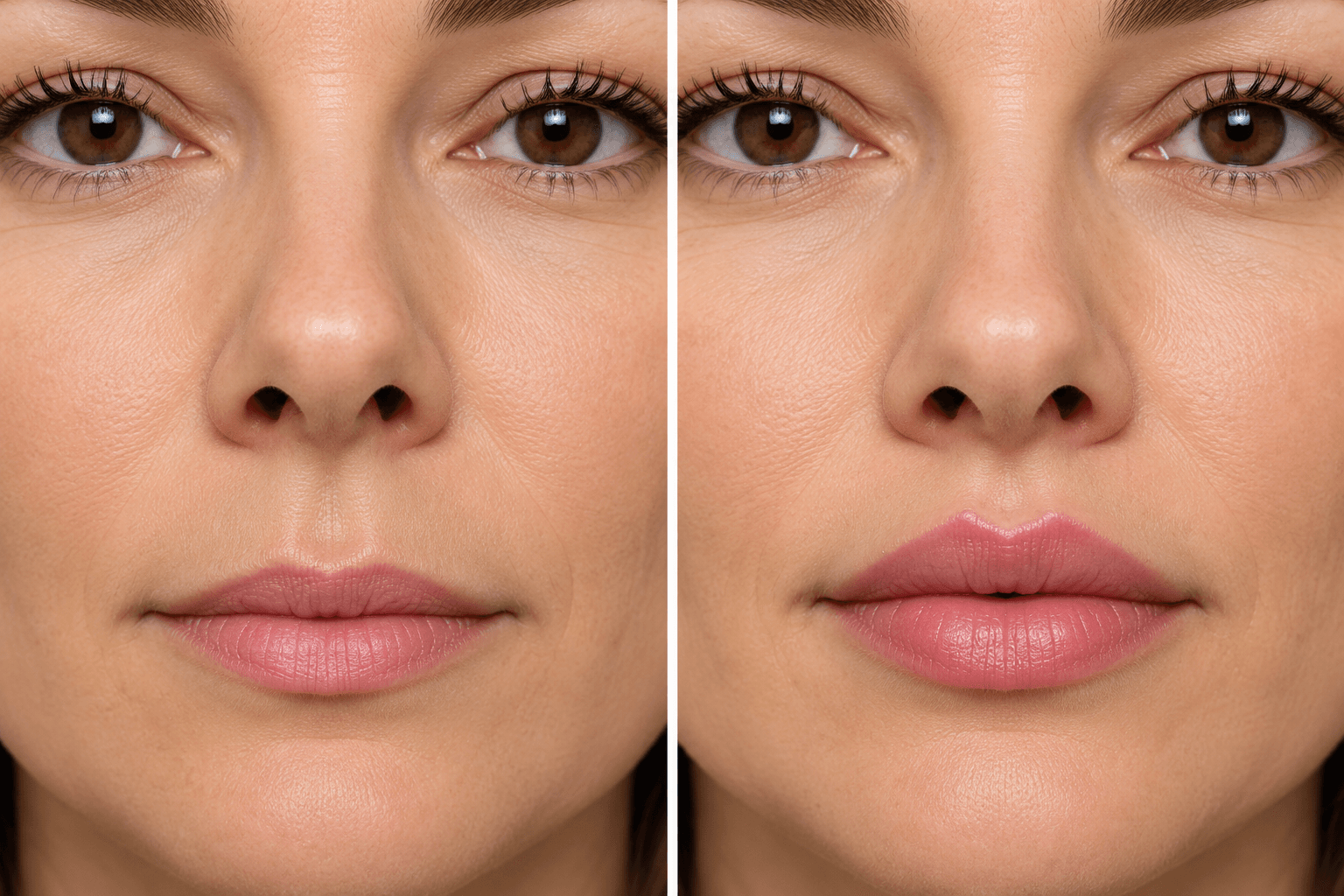
What a lip lift changes, how proportion drives a natural result, the techniques, the scar, the recovery, and the revision rate nobody mentions.