
Endoscopic Facelift: Benefits, Procedure, and Recovery
What an endoscopic facelift can and cannot achieve, how the procedure works, what recovery involves, and who tends to be a suitable candidate.

An endoscopic facelift is a minimally invasive facial rejuvenation technique in which the surgeon works through several short incisions hidden in the hairline, guided by a small camera that projects a magnified view onto a monitor. It repositions descended tissue in the brow, forehead and midface rather than removing large amounts of skin, which is why it suits some patients very well and is the wrong choice for others. Recovery is typically shorter than with open techniques, though healing varies considerably from person to person.
That last point deserves emphasis from the outset. The endoscopic approach is not a smaller version of every facelift. It is a different tool, with a specific range of problems it solves well and clear limits beyond that range. Understanding where those limits fall is more useful than any list of advantages.
What Is an Endoscopic Facelift?
The word endoscopic describes how the surgeon sees and reaches the surgical field, not what is corrected.
In a conventional open facelift, the surgeon makes a longer incision, typically running in front of the ear, around the earlobe and back into the hairline, and lifts tissue under direct vision. In an endoscopic procedure, several incisions of roughly one centimetre are placed within the hair. A thin endoscope is introduced through one of them and transmits a magnified, well-lit image of the tissue planes to a screen. Fine instruments pass through the remaining openings while the surgeon works from that view.
Beneath the skin lies a layer of muscle and connective tissue known as the superficial musculoaponeurotic system, or SMAS, which is anchored to the underlying bone by retaining ligaments. As those ligaments loosen with age, the soft tissue they support descends. Endoscopic technique allows the surgeon to release selected ligaments and reposition that deeper layer upward, securing it in its new position. The skin is then redraped rather than pulled.
Because the incisions are deliberately short, the amount of skin that can be removed through them is limited. This single constraint explains most of what follows. For a detailed walkthrough of the operative sequence, see our guide to how endoscopic facelift surgery is performed.
What Are the Potential Benefits of an Endoscopic Facelift?
The advantages of this technique follow directly from the approach rather than from any claim of inherent superiority.
Incisions concealed within the hair. The short incisions sit in the hairline or scalp, meaning no scar line runs in front of or behind the ear. Once healed and once hair has regrown over them, most patients find them difficult to locate. Every incision still produces a scar, and healing quality varies between individuals.
Less tissue disruption. Reaching the surgical plane requires less dissection than an open approach. In practice this often translates into less bruising and swelling, and many patients find the early recovery period more manageable than they anticipated.
Magnified visualisation. Working under an enlarged view allows nerves, vessels and tissue planes to be identified clearly before instruments pass near them. This supports precision, though it does not eliminate surgical risk.
Repositioning rather than skin tension. Because the lift is generated by moving the deeper layer, the skin is not required to hold tension. Skin under sustained tension can produce the drawn appearance patients often want to avoid, and tends to relax over time. Removing tension from the equation supports a result that moves naturally, a principle examined further in our article on facelift techniques for lasting natural results.
Effectiveness in the upper and middle face. The brow, forehead and midface respond particularly well to this approach, because the problem in these regions is usually descent of tissue rather than excess skin.
Compatibility with other procedures. An endoscopic lift can be combined with eyelid surgery or fat grafting when appropriate, allowing several concerns to be addressed in a single anaesthetic.
What this technique does not do is equally worth stating. It does not improve skin texture, pigmentation or fine surface lines. It does not replace lost facial volume. And it does not halt ageing, which continues from whatever new starting point surgery creates.
Who May Be a Candidate for an Endoscopic Facelift?
Suitability rests on anatomy rather than age, though the two often correlate.
The patients who benefit most tend to show descent in the brow, forehead or midface while retaining reasonable skin elasticity. They may notice that their brows sit lower than they once did, that the upper eyelids appear heavier as a result, that cheek volume has slipped downward, or that the folds between nose and mouth have deepened. Crucially, their skin itself has not become markedly lax.
Good general health matters, including blood pressure that is well controlled, since poorly controlled hypertension is associated with higher bleeding risk after facial surgery. Existing conditions, bleeding disorders and current medication all require discussion well before any surgical date is considered. Nicotine in any form, including vaping and replacement products, restricts the small vessels supplying surgical skin flaps and impairs healing, so surgeons generally require a period of abstinence before and after surgery.
Realistic expectations complete the picture. Patients who do well want to look like a rested version of themselves and are deciding for their own reasons.
When this technique is not the right choice. Patients with significant skin laxity, pronounced jowling or substantial neck involvement will not achieve a complete result from an endoscopic approach alone, because short incisions cannot accommodate meaningful skin removal. For these concerns, an open technique such as a high-SMAS facelift or a deep plane face and neck lift is generally more appropriate.
This is a question of matching the operation to the anatomy, not of one technique outranking another. A patient with heavy neck laxity treated endoscopically will be disappointed; the same patient treated with an open approach may be delighted.
Patients in their late thirties with minimal descent are often better served by waiting, or by non-surgical options that achieve what they are actually seeking with far less recovery involved.
How Is an Endoscopic Facelift Performed?
Every operation begins with assessment. The surgeon examines the face at rest and in animation, evaluating skin quality, the pattern and degree of tissue descent, bone structure, symmetry and the neck, before determining whether the endoscopic approach fits the case. Our guide to what happens during an aesthetic consultation covers this stage in detail.
Anaesthesia. The procedure is typically performed under general anaesthesia or deep intravenous sedation combined with local anaesthetic. The choice depends on the extent of surgery, the patient's health and the anaesthetist's assessment. Fasting instructions are given in advance.
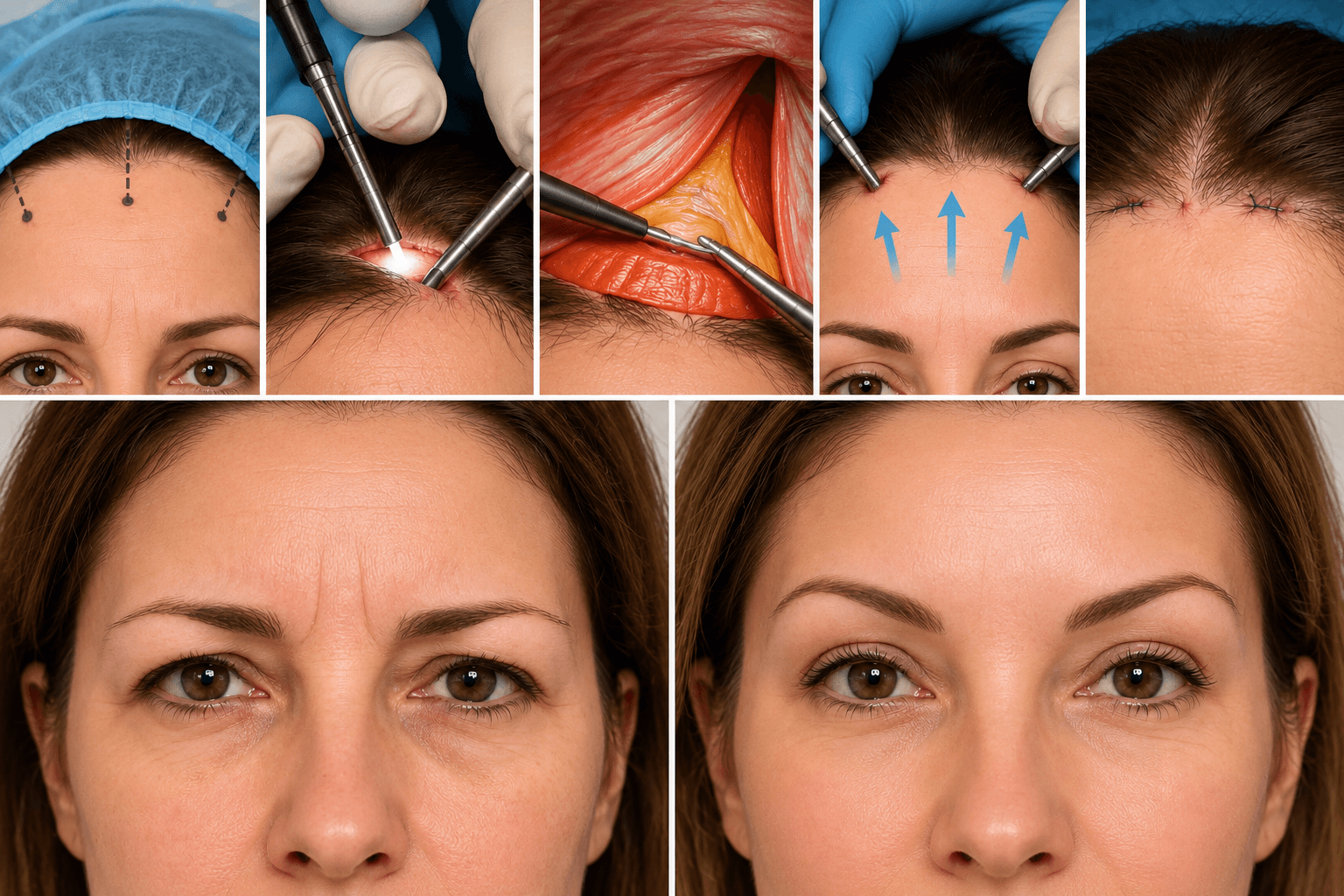
Incisions. Three to five incisions of approximately one centimetre are placed within the hairline or scalp. Their exact positions depend on which regions are being addressed and on the patient's hairline, and in men on the location of beard-bearing skin.
Endoscopic dissection. The endoscope is introduced and the surgeon works beneath the skin in a defined anatomical plane, identifying structures under magnification before releasing the retaining ligaments that hold tissue in its descended position.
Repositioning and fixation. Once released, the soft tissue is elevated into its new position and secured. Several fixation methods exist, including sutures anchored to deeper tissue or to bone, and small absorbable devices. The choice depends on the surgeon's training and the specific technique used.
Closure. The short incisions are closed with fine sutures. A light dressing is applied.
Duration and discharge. Operating time varies with the number of regions treated and whether other procedures are combined. Many patients are observed for a period afterwards, and blood pressure monitoring is a meaningful part of reducing the risk of a haematoma.
Several endoscopic techniques are available depending on the region concerned, including the endoscopic brow lift, the endoscopic forehead lift, the MM Lift for the midface and the endoscopic deep plane facelift. Which applies to a given patient is determined at consultation.
Endoscopic Facelift Recovery: What to Expect
Recovery follows a reasonably predictable rhythm, but pace differs between individuals. The timeframes below are general guidance rather than a schedule anyone should measure themselves against.
The First Few Days
Swelling typically peaks within the first two to three days. Most patients describe tightness and pressure rather than sharp pain, and discomfort is generally managed with prescribed medication. Keeping the head elevated, including during sleep, makes a measurable difference to swelling. Rest matters more during this window than at almost any other stage.
The First One to Two Weeks
Swelling begins to settle and any bruising changes colour as it fades. Gentle walking is usually encouraged, since light movement supports circulation without straining healing tissue. Sutures are commonly removed within this period, and many patients return to desk-based work towards the end of it, though this depends on the extent of surgery.
Weeks Three to Six
Most visible swelling has resolved by this stage, although subtle residual swelling, often noticeable only to the patient, may persist. Light exercise typically resumes during this window, with more demanding activity following according to the surgeon's guidance. Numbness around the incisions is common and improves gradually as sensory nerves recover.
Longer-Term Healing
Deeper tissue continues to settle over the following months, and scars continue to mature and fade for up to a year. Most patients see something close to their settled result somewhere between three and six months. Judging an outcome at three weeks, when swelling still masks the contour, is premature and almost always unfair to the result.
What Are the Risks and Possible Complications?
All surgery carries risk, and the endoscopic approach is no exception. The points below are set out so they can be weighed, not to alarm.
Haematoma, a collection of blood beneath the skin, is among the more common early complications in facial surgery and may require drainage. The risk is associated with uncontrolled blood pressure, which is why monitoring is taken seriously after surgery.
Facial nerve injury. Branches of the facial nerve run through the surgical territory. Temporary weakness can occur, usually because a nerve has been stretched rather than divided, in which case function generally returns over weeks to months. Permanent injury is uncommon but cannot be excluded.
Altered sensation. Numbness around the incisions and in the treated area is expected rather than a complication, resulting from division of small sensory nerves. It improves over months, though small areas of altered sensation occasionally persist.
Scarring and hair-related changes. Incisions within the scalp can occasionally be associated with hair thinning along the scar line.
Impaired wound healing, more frequent in smokers, along with infection, asymmetry and contour irregularity, all remain possible.
Under-correction. Where an endoscopic approach is applied to a patient whose anatomy called for a more extensive technique, the result may appear incomplete rather than unnatural. This is a selection issue rather than a complication, and it is best avoided at the consultation stage.
Anaesthetic risks apply as with any procedure requiring general anaesthesia or sedation.
Your risk profile depends on your individual health, anatomy and the specific procedure planned, and should be discussed in detail before any decision is made.
Endoscopic Facelift vs. Traditional Facelift
Endoscopic Traditional open Incisions Several short, within the hairline Longer, around the ear and into the hairline Visualisation Magnified, via camera Direct vision Skin removal Limited Allows significant removal Best suited to Brow, forehead, midface descent Lower face, jawline, neck laxity Tissue disruption Less More Recovery Often shorter Generally longer Visible scar near ear None Present, typically well concealed
The honest summary is that these techniques address overlapping but distinct problems. Endoscopic methods excel at repositioning; open methods are required when excess skin must be removed. Many patients are best served by one or the other, and some by a combination. The full range of approaches is set out on our facial surgery overview.
How Long Can Results Last?
Surgery repositions tissue; it does not stop ageing. The process continues from the new starting point the operation creates, which is why patients generally continue to look better than they would have without surgery, while still ageing normally.
How long a result holds depends on genetics, skin quality, weight stability, sun exposure, smoking and the technique used. Claims that a particular technique reliably outlasts another by a set number of years should be treated with caution, since individual variation is substantial. Sun protection, stable weight and not smoking all support longevity.
Cost is often raised alongside longevity, and the two are related through the extent of the procedure rather than through any guarantee. Our article on what determines facelift cost explains which factors change the figure.
How to Prepare for a Consultation
A consultation is where the question of technique is actually answered, and preparation makes it more productive.
Bring a clear account of your medical history, including existing conditions, previous surgery, allergies and every medication and supplement you take. Do not stop any prescribed medication on your own initiative; any changes should be directed by the clinician who prescribed it, in coordination with your surgeon.
It helps to arrive with specific concerns rather than general ones. Knowing which changes bother you most allows a more precise assessment than a general wish to look younger.
Questions worth asking include which technique is recommended for your anatomy and why, what the alternatives are including doing nothing, which risks are most relevant in your case, what recovery is likely to involve for you, and how follow-up care is organised.
You should not feel pressured to decide on the day.
Frequently Asked Questions
Is an endoscopic facelift suitable for everyone?
No. It suits patients with descent in the brow, forehead or midface who retain reasonable skin elasticity. Those with significant skin laxity or neck involvement generally require an open technique, because short incisions limit how much skin can be removed.
Will the scars be visible?
The incisions are short and placed within the hairline or scalp, so no scar runs in front of or behind the ear. Once healed and covered by regrown hair they are usually difficult to see. No surgery is scar-free, and healing varies between individuals.
How painful is the recovery?
Most patients describe tightness and pressure rather than severe pain, with discomfort managed by prescribed medication in the early days. Pain that is sudden, severe or one-sided should be reported to your surgeon promptly.
When can I return to work?
Many patients return to desk-based work within one to two weeks, though this depends on the extent of surgery and individual healing. Physically demanding work requires longer. If you have an important commitment, allow more margin than the minimum.
Does an endoscopic facelift improve the neck?
Not meaningfully. Neck laxity generally requires dedicated techniques such as a neck lift or platysmaplasty. Whether these are needed in your case is determined by examination.
Book a Consultation at Endoface
This article is educational and cannot replace an individual medical assessment. Whether an endoscopic approach suits you depends on your anatomy, your skin and what you want to change, none of which can be evaluated from a photograph or an article.
Dr. Mubariz Mammadli, medic primar chirurgie plastică, offers plastic and aesthetic surgery by appointment in Bucharest, Naples and Baku. Each case is assessed individually.
If you would like to understand which technique would be appropriate for you, arrange a consultation or view results from previous patients. Results vary between patients.
English-speaking and international patients can also browse the full range of procedures on Dr. Mubariz Mammadli's international website, or book directly there.
Medically reviewed by Dr. Mubariz Mammadli, medic primar chirurgie plastică. Last reviewed: [18.10.2026]. This content is provided for general information and does not constitute medical advice. Individual assessment by a qualified surgeon is required before any procedure. Outcomes, recovery and risks vary between patients.
About the author
Dr. Mubariz Mammadli
Plastic surgeon
Dr. Mubariz Mammadli offers advanced plastic surgery and aesthetic treatments in Bucharest, Naples and Baku, with a refined, patient-first approach.
View full profileRelated treatments
Want a tailored opinion? Schedule a discreet consultation with Dr. Mubariz Mammadli.
Related reading
Aesthetic medicine blog
Education
Endoscopic Brow Lift: Procedure, Risks and Recovery
An endoscopic brow lift lifts the brow through small incisions behind the hairline. How it is done, who it suits, the real risks and recovery.

Education
8 Facial Rejuvenation Methods: Which Is Most Effective?
Facial rejuvenation methods compared: what each of the 8 actually fixes, how long it lasts, and why the most effective one depends on your face.
Education
Endoscopic Lift vs Classic Lifting Techniques
Endoscopic lift vs classic lifting techniques complete comparison: incisions, scars, recovery and precision. How to choose the right technique.